INTELLIGENT EMERGENCY RESPONSE INFRASTRUCTURE
When every
second of care
matters.
Knowing what to do next shouldn't
be the hardest part.
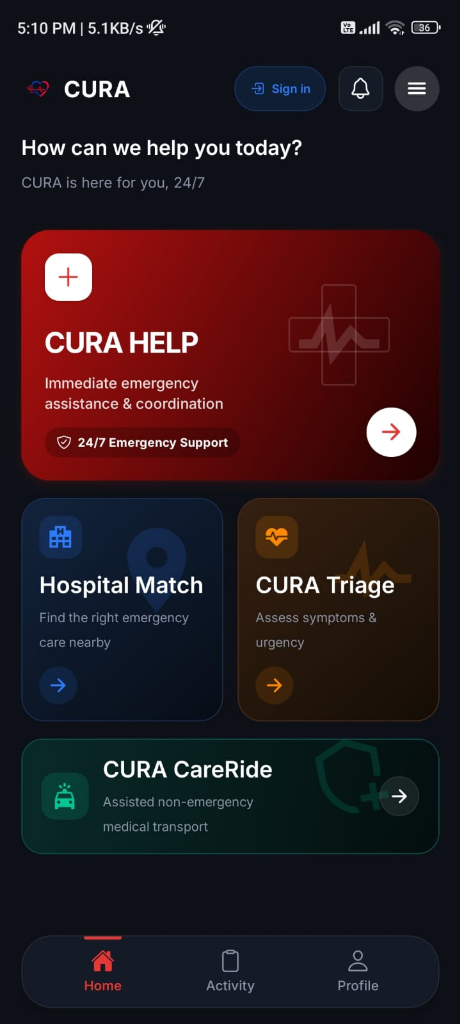
An emergency shouldn't become a coordination problem.
During a medical crisis, patients and families face critical decisions under extreme uncertainty.
Decision Hesitation
Uncertainty about urgency level leaves families debating whether to call an ambulance, visit urgent care, or wait.
Unmatched Mobility
Ambulances are often over-utilized for non-critical transport, while critical cases face transit delays.
Nearest vs Appropriate
Patients frequently head to the closest hospital rather than the facility with the right specialty on duty.
Cold Arrival
Receiving emergency teams rarely have structured pre-arrival context before the patient reaches the door.
One coordinated
response pathway.
CURA connects the fragmented emergency journey into a clear,
protocol-driven decision flow.
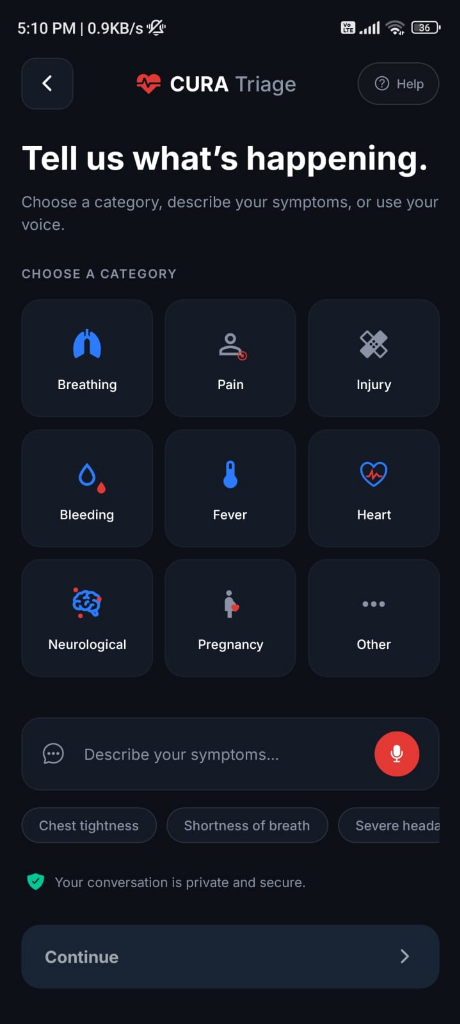
URGENCY TRIAGE
Assess symptoms, severity, onset and relevant context to determine urgency and appropriate escalation level.
APPROPRIATE TRANSPORT
Guide the response toward the appropriate transport pathway based on urgency and mobility requirements.
SMART HOSPITAL MATCH
Match the patient with an appropriate receiving facility based on care requirements and hospital context.
HOSPITAL PRE-ALERT
Provide structured pre-arrival information to the receiving hospital where integration is supported.
Built to assess urgency — not diagnose.
CURA is engineered with strict clinical safety guardrails to support emergency decision-making without overstepping clinical authority.
Urgency Assessment, Not Diagnosis
CURA evaluates symptom urgency for escalation and routing; it does not issue clinical diagnoses, prescribe treatments, or replace medical consultations.
Protocol Escalation, Not EMS Replacement
CURA works alongside public emergency services (911/112). Critical life-threatening emergencies automatically trigger immediate official EMS activation.
Guided Mobility, Not Ride-Hailing
CURA CareRide operates strictly within defined protocol boundaries for non-critical mobility support, ensuring patient safety throughout transit.
Decision Support, Not Substitution
All clinical care decisions remain exclusively with licensed medical professionals, emergency physicians, and certified paramedics.
Right hospital care, not just the nearest location.
The closest emergency room is not always equipped for specialized conditions like pediatric trauma, stroke intervention, or cardiac catheterization. CURA matches patients based on facility capabilities and urgency context.
Care coordination shouldn't begin at the hospital door.
CURA is designed to support structured pre-arrival information sharing with receiving hospitals where integrated. Emergency clinical teams receive critical intake context prior to arrival, allowing receiving rooms and specialists to prepare in advance.
Built for an interconnected ecosystem.
CURA serves as the central coordination layer uniting key stakeholders across the emergency response continuum.
Patients & Families
Clear guidance during high-stress moments
Transport Networks
Optimized EMS & assisted mobility routing
Hospitals & ERs
Structured intake & pre-arrival context
Clinicians
Protocol-aligned decision support tools
Institutions
Regional emergency coordination protocols
Help build a more coordinated emergency response ecosystem.
We invite healthcare leaders, clinicians, emergency medicine experts, transport networks, and strategic partners to collaborate with CURA.